Security operations software
ROGR
A patrol planning system that turns site inspection rules into validated guard schedules, with a manager workspace, a driver web app, and a native driver build inside ROGR's existing Android app.
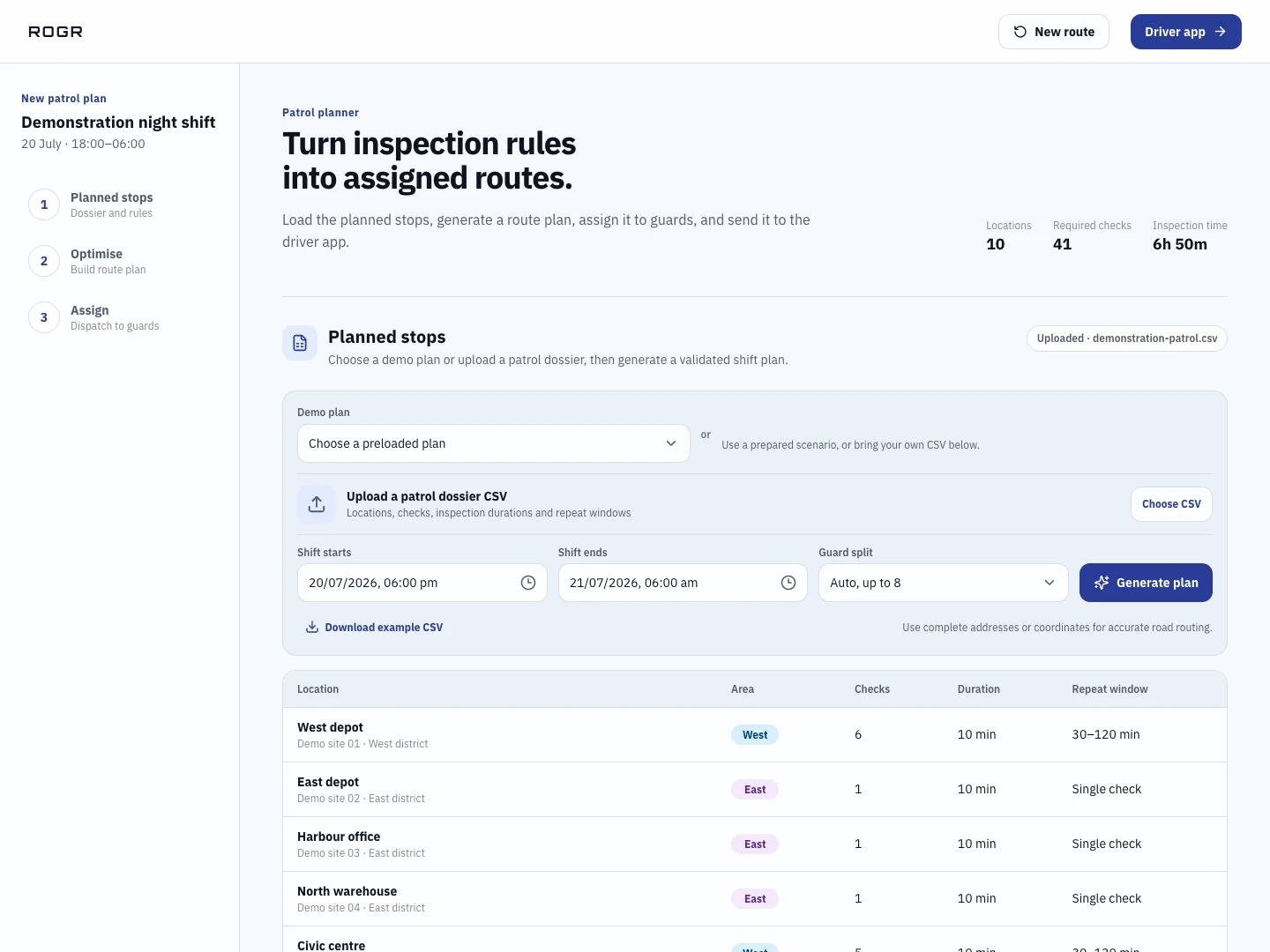
A 41-check night shift proven impossible for one guard — 41 minutes short before any route search — and a validated two-guard split that completes every check.
- 41 min short
- One guard ruled out before any search
- 2 guards, 41 checks
- A split that passes the validator
- 3 outcomes, not 2
- A search that gave up says so
- Period
- Jul – Oct 2026
- Sector
- Security operations
- Organisation
- ROGR
My contribution
We built the Python scheduling engine and its independent validator, the planning API, the manager workspace and driver PWA, and a native driver surface inside ROGR's production Android app.
- Rule-aware patrol scheduling across repeat inspections, overnight windows and breaks
- Capacity screening that proves an overloaded shift before any route search runs
- Manager workspace for dossier intake, route comparison and guard assignment
- Driver PWA and a native Android driver build with Google turn-by-turn guidance
The result
A deployed planning API, a manager workspace and a driver PWA, plus a native Android driver surface running against the same solver inside ROGR's existing app.
Engagement
Scheduling engine, planning API and driver software
The problem
Security patrols revisit the same sites throughout a shift. Each inspection must fit its own time window and repeat interval, with enough time left for driving, inspection work and breaks. A short route alone does not make a workable patrol, and a planner that answers "no route found" tells a manager nothing about whether the shift is impossible or the search simply gave up.
How it was approached
- Model inspection counts, repeat intervals, timing windows, shift boundaries and planned downtime as explicit rules, held in an input file the client can change and regenerate from.
- Screen shift capacity against a conservative lower bound before spending any search time on a workload that cannot fit.
- Search under every hard constraint, then re-check each visit and travel leg with a validator written separately from the search itself.
- Drive travel from Google Routes for road durations, distances and geometry, keeping recorded matrices so solver checks stay deterministic and need no network.
- Carry the validated plan into the driver's hands, in a browser or inside ROGR's own Android app.
How far up the stack the work reached
ROGR already had a production Android app and a site rules dossier. The engine, API and planning interfaces are new; the native driver runs as an isolated build variant, leaving production code, auth and API contracts untouched. Guard skills, vehicles and working-time policy are not yet typed constraints.
Patrol operation
Guards, shifts, sites and ROGR's inspection rules dossier.
Planning API
Validated CSV and typed JSON intake, deployed as a container service.
Scheduling
Capacity screening, constraint search and independent validation.
Manager workspace
Route comparison, schedules, escalation and guard assignment.
Driver web app
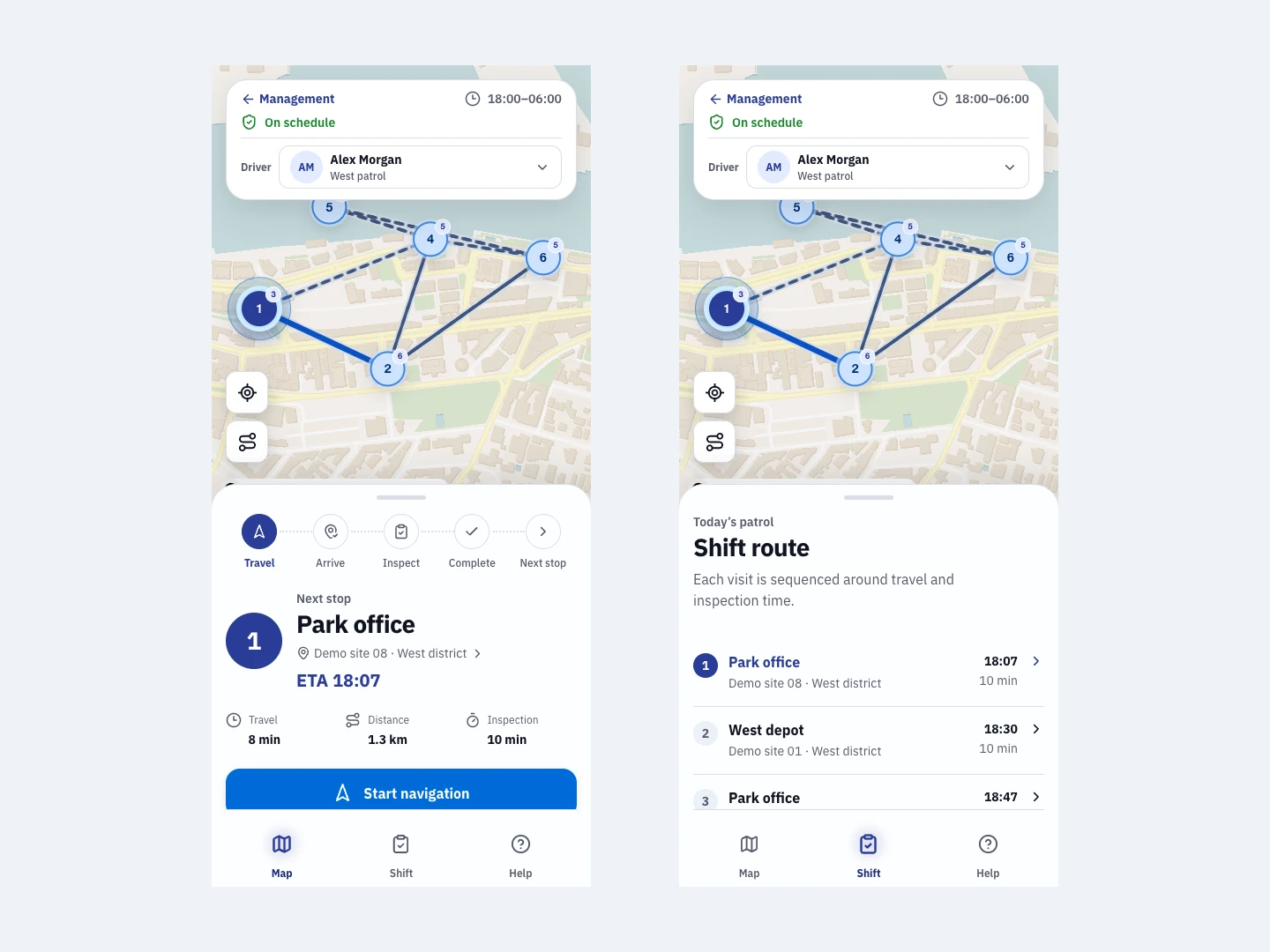
Route map, next stop, shift sequence and inspection progress.
Native driver
An isolated build variant inside ROGR's existing Android app.
What was built
Scheduling engine
Build patrols around the rules of the shift, not the map.
- Repeat inspections, overnight windows and several rules per site
- Travel, inspection duration, breaks, downtime and shift limits
- Feasible, infeasible or indeterminate — an exhausted search is never reported as impossible
Capacity and allocation
Prove the workload fits before looking for a route.
- An optimistic lower bound that can rule out one guard before any search
- Automatic or manager-defined sectors, up to eight concurrent routes
- Every proposed split solved and validated, not merely balanced by workload
Manager workspace
Review the workload before committing a guard to it.
- CSV dossier upload, shift controls and a deployed planning API
- Single-guard capacity checks against multi-guard route comparison
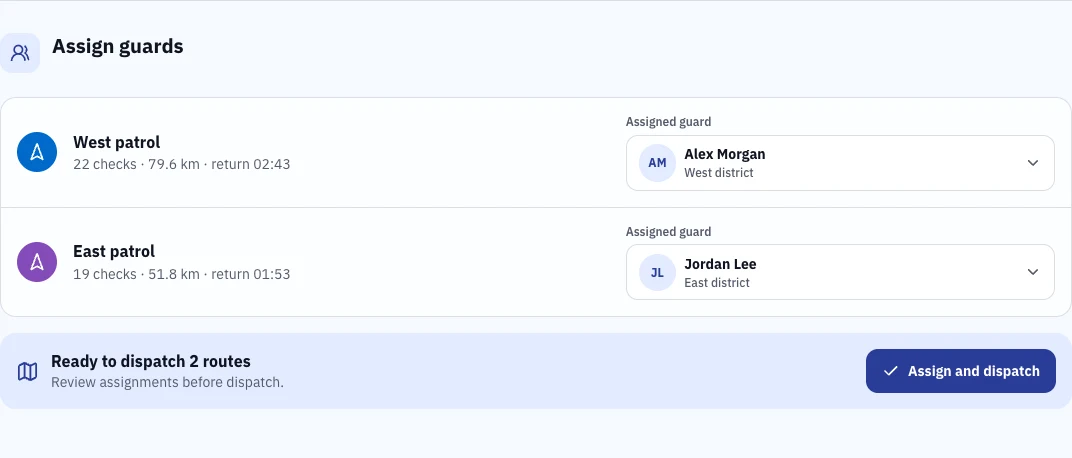
- A bounded comparison with a full-budget rerun, then guard assignment
Driver apps, web and native
Keep the next action unmistakable during a patrol.
- Installable PWA with route map, inspection countdown and offline fallback
- A native driver surface inside ROGR's existing Android app, as an isolated build
- Google Navigation SDK turn-by-turn, voice and rerouting in ROGR's own styling
What changed
Every figure here is observable in the delivered repository, product or artefacts.
41 min short
One guard ruled out before any search
In a 41-check night shift built from ROGR's own rules dossier and recorded travel matrix, an optimistic lower bound reached 12 h 41 min against a 12 h shift. No ordering could recover that, so no route search was run.
2 guards, 41 checks
A split that passes the validator
The generated two-guard plan covers 22 checks over 79.6 km and 19 over 51.8 km, both returning to their anchor site inside the shift with every repeat interval and planned break respected.
3 outcomes, not 2
A search that gave up says so
Plans come back feasible, infeasible or indeterminate, and feasible ones report whether optimality was proven. A manager can rerun an unresolved comparison at the full search budget instead of guessing.
100 visits
Validated at benchmark scale
A validator written separately from the search re-checks every visit and travel leg before a plan is called compliant. Benchmarks at 25 and 50 sites — 50 and 100 required visits — complete with zero validation errors.
Technical stack
Python
Flask
TypeScript
Next.js
Kotlin
Google Navigation SDK
Google Routes API
MapLibre
IndexedDB
Docker
Capabilities applied
Scheduling optimisation
Constraint modelling
Operational software
Native Android development
Web app development
API integration
From the project
3 frames
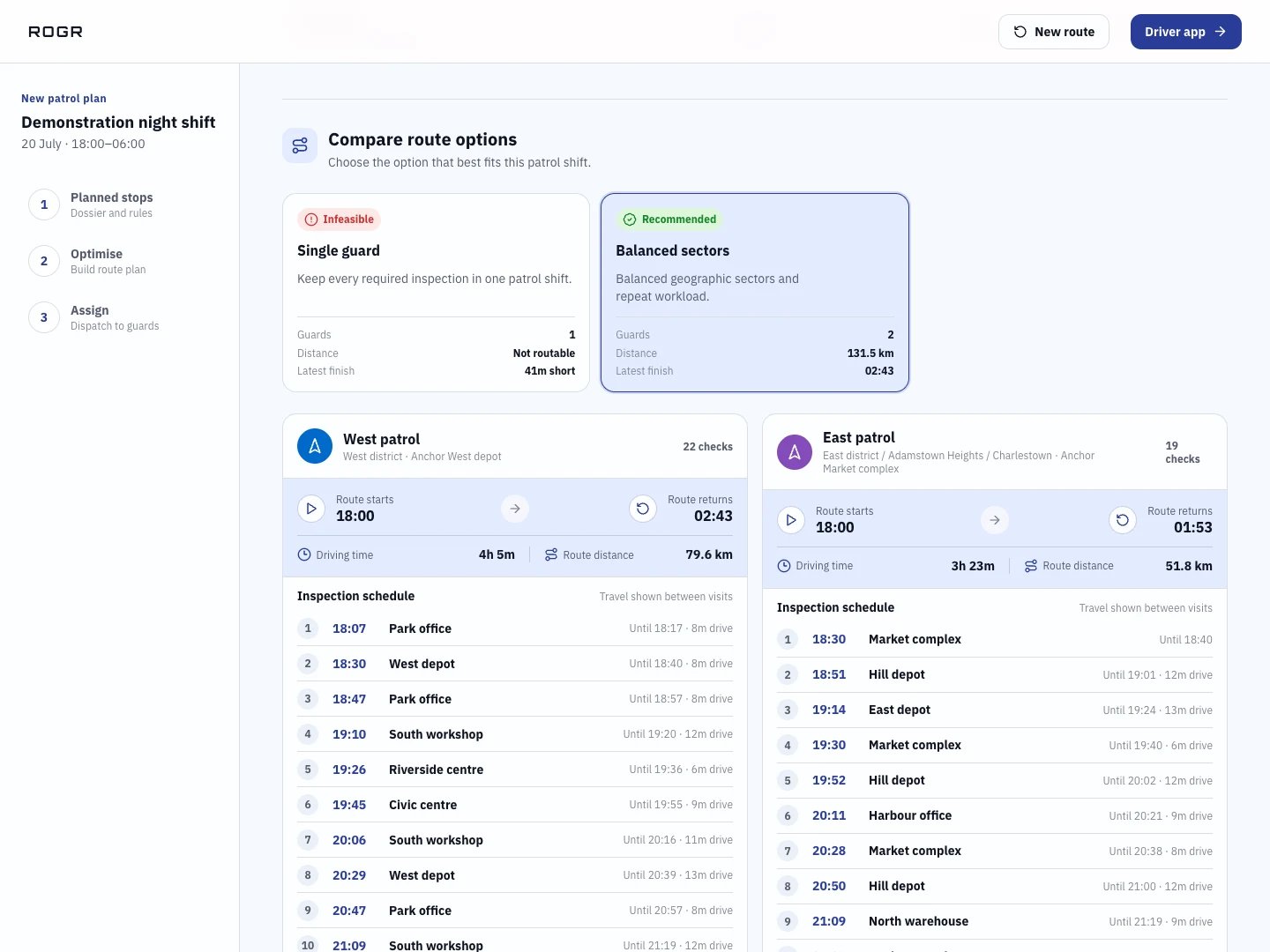
Capacity, route options and inspection schedules compared side by side, using demo data.
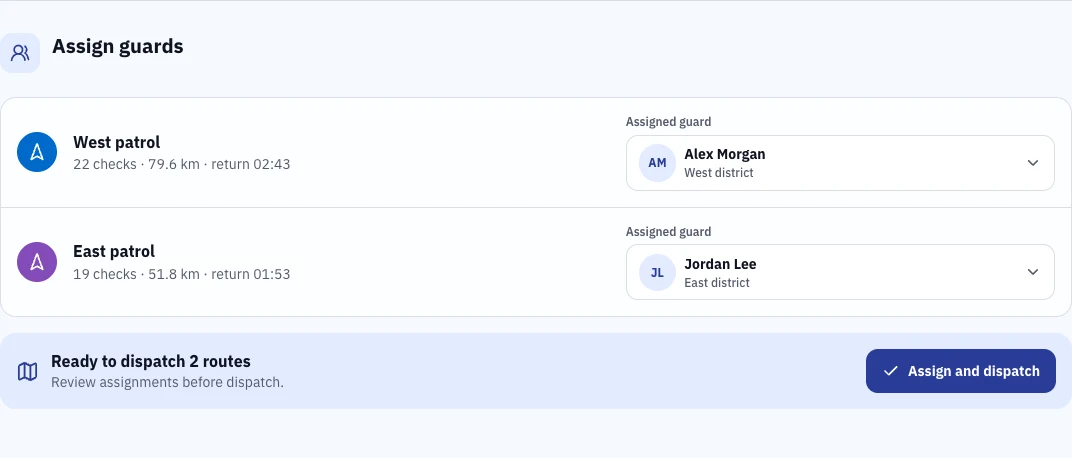
Assign a guard to each validated route and hand the plan to the driver app.
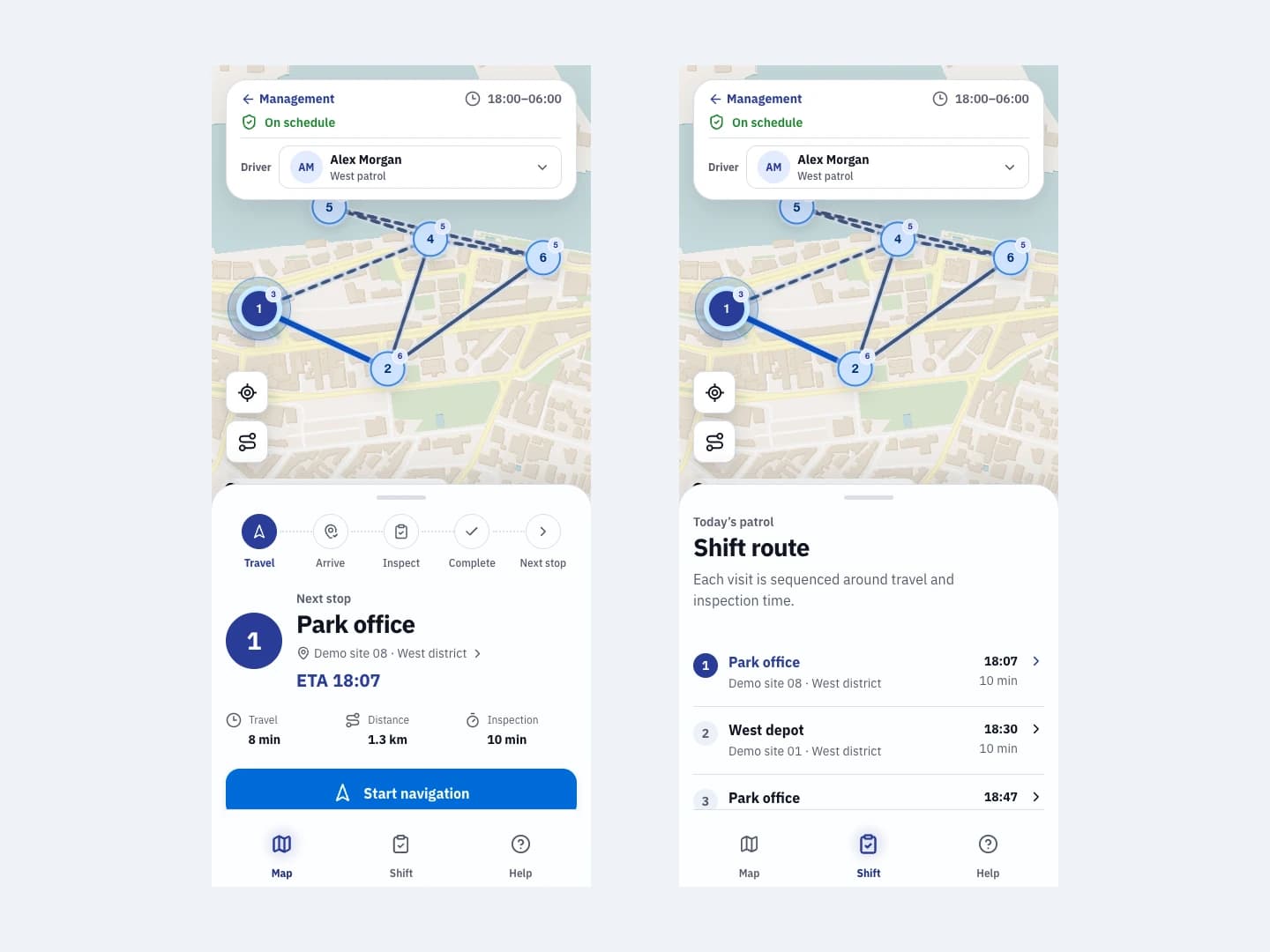
The driver app: next-stop guidance and the full shift sequence, shown with demo data.
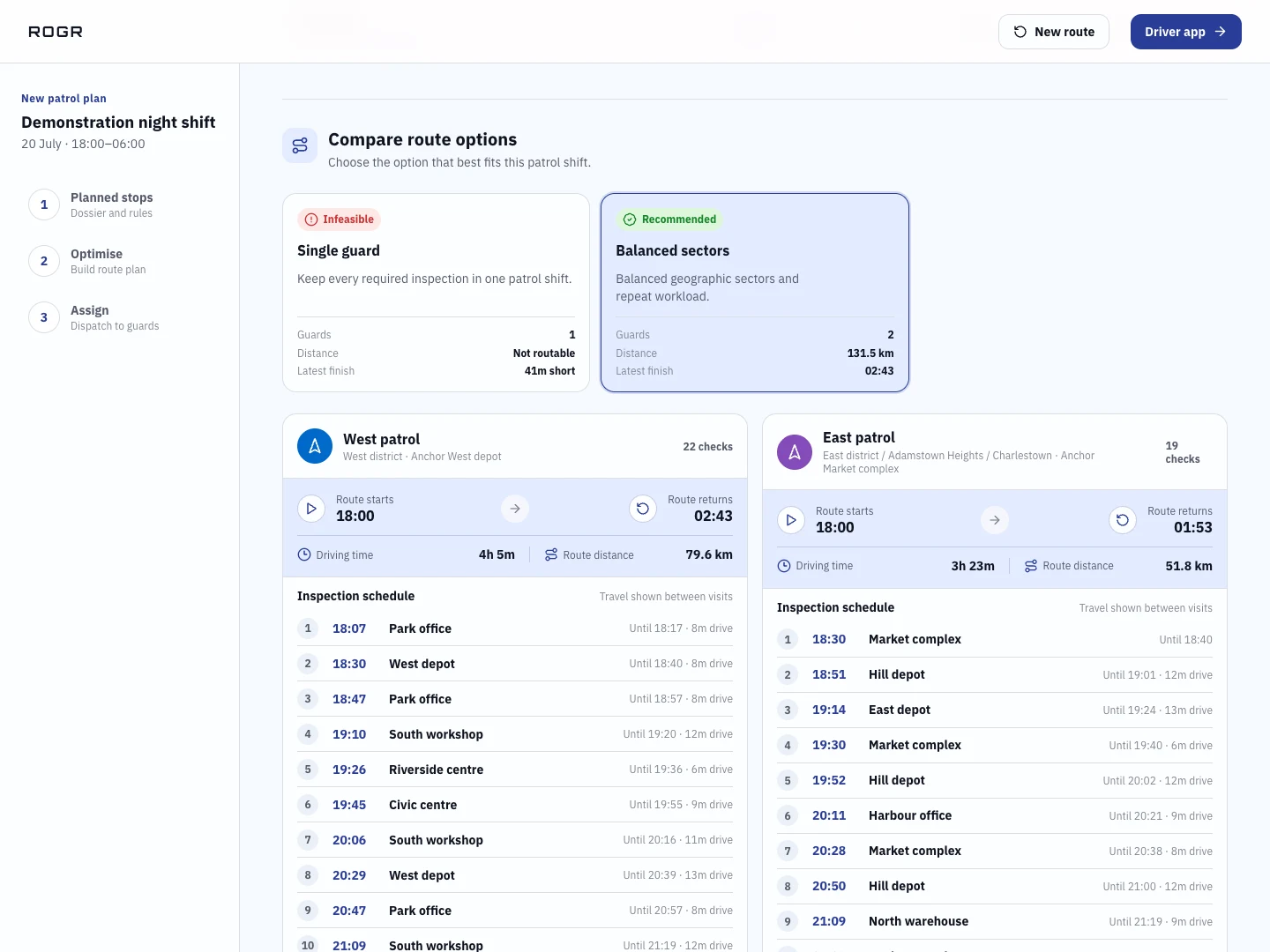
Frame 1 of 3: Capacity, route options and inspection schedules compared side by side, using demo data.
More projects
Equiomics
The client raised $200K in venture funding to deliver stage one of the project.
Equine product engineering

AROBOTIX
Crews work from the building model instead of from spreadsheets and memory.
Construction software
RemixCode
Buyers can see what is inside a piece of software and reach the people who can change it.
Software marketplace
Willbot
A broker gets a ranked lender answer with the policy rows it came from.
Lending software
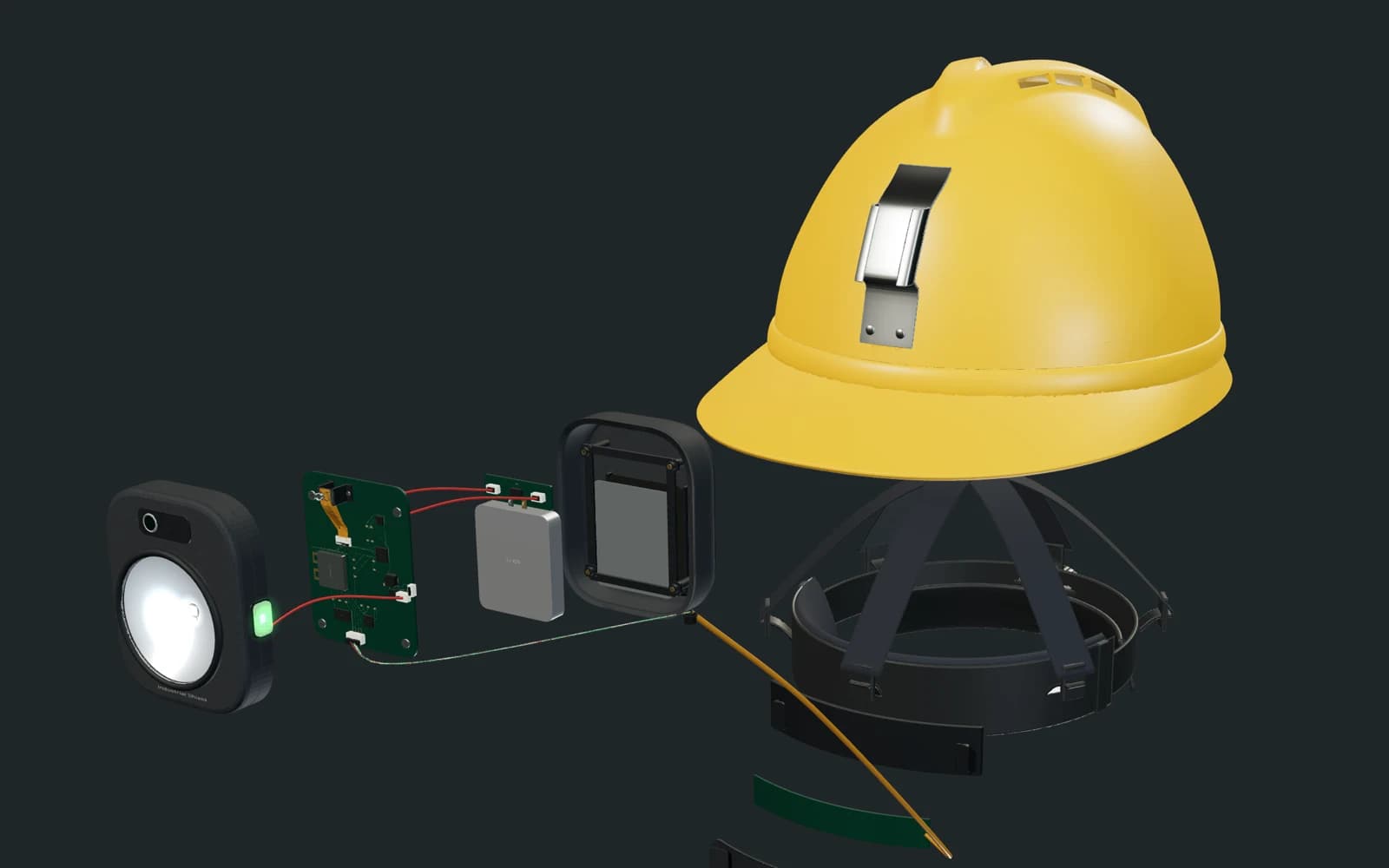
Industrial Shield
A four-layer board, enclosure and firmware carried to a working helmet prototype.
Embedded product development

Industrial monitoring and control
Three sensing nodes, one gateway, and the engineering needed to connect them.
Connected hardware and controls
Motikon
Leaders see which part of the organisation is under stress, and for how long.
Workplace wellbeing software
MarineWise
Seller uploads are checked before anyone sees them, in a queue that does not hold up the listing.
Marine marketplace
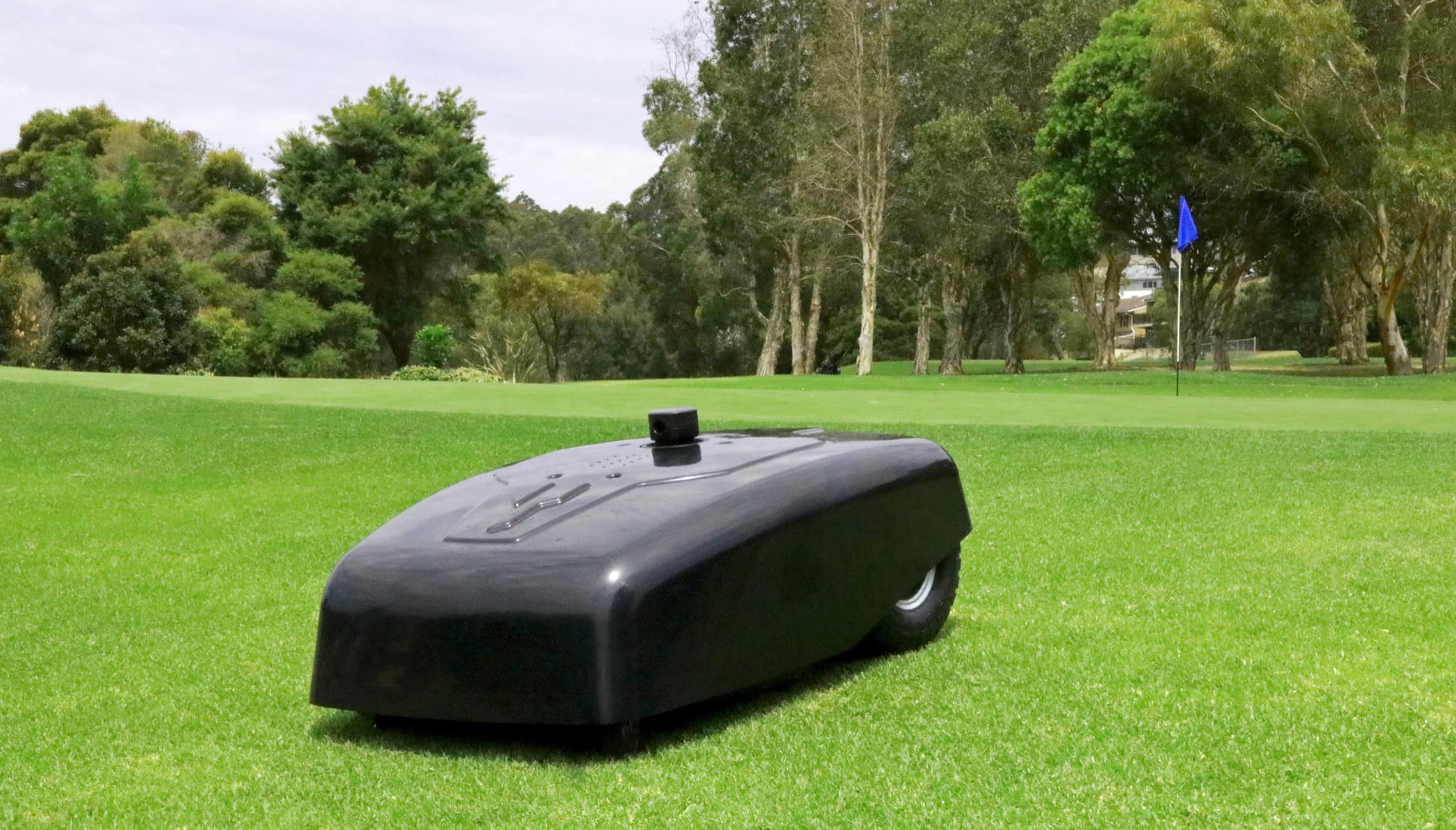
Elite Robotics
A working mower prototype, trials with three customers, and $128K in investment and grants.
Autonomous robotics